It was some years ago now that I sat in the Piccadilly Theatre in London and laughed so much that my throat hurt. It would be reasonable to surmise that I had been watching a comedy performance of some sort but no! I was in fact listening to the author Alexander McCall Smith being interviewed as part of a literary tour promoting a new book. He was utterly hilarious and delightfully self-deprecating. I would imagine he is an interviewer’s dream, as once he had started talking he really didn’t need further questions or prompts. He simply entertained the audience for an interesting and enjoyable hour and a half.
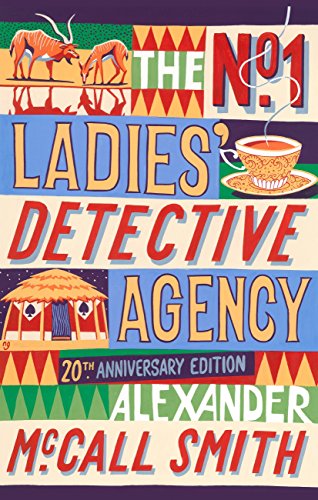
I suspect that many of you have sampled the series beginning with The Number 1 Ladies Detective Agency, starring Mma Ramotswe. They hit the bookshops in 1998 and caused a publishing sensation as there was nothing quite like them on the market.
I enjoyed the storylines but was far more attracted to the later series, particularly those situated in Edinburgh and a particular, slightly Bohemian corner of the city, full of eccentric characters and the minutiae of everyday life.
44 Scotland Street is the first in a now long line of books, allowing McCall Smith the pleasure of developing his characters and giving them depth, which as a reader I find satisfying. Also interesting is the fact that initially the Scotland Street stories were serialised in a daily newspaper, resulting of course in very short chapters which I like. Late at night I can always convince myself that I will just read one more chapter, just one more!
There is of course an historical and literary precedent for this business of serialising stories. Charles Dickens famously used the technique to publish many of his social reforming works. It does require the creation of a cliff hanger, however small, at the end of each daily or weekly section, a little like the conclusion of a soap episode. I will leave you to add the dum, dum, dum drumbeats at the end of Eastenders yourself!
Flaubert’s Madam Bovary was serialised, deemed to have frequent examples of obscenity within the text and nearly landed the author in jail. The tales of Scotland Street would cause no such worries and concerns. The writing is gentle, incredibly perspicacious and frequently very funny. There is much in real, everyday life that is amusing and peculiar but it takes a special sort of writer to be able to put these into words and weave tiny situations into stories.
A more contemporary author who has experienced the deadline drama of being published on a daily basis is the Californian Armistead Maupin, author of Tales of the City who worked with The San Francisco Chronicle for many years telling the backstories of a variety of Californian characters. Maupin does this sympathetically I seem to remember but, to employ a word my mother would have used, the writing is decidedly ‘racy!’ McCall Smith, on a trip to the west coast of America, met Armistead Maupin, who in conversation lamented the demise of the serialised novel. On his return to Scotland, after discussion with the editorial staff of The Scotsman, Alexander McCall Smith was contracted to provide a daily slice of Edinburgh life to the readers of the newspaper. The main downside to which he had to accustom himself was that he could not go back and change anything. He has commented that sometimes this was trying!
And so, we are on the edge of the New Town in Edinburgh where number 44 Scotland Street is a tall Georgian house separated into a number of flats. This is already pleasing and I can see how a writer can assemble a group of disparate characters who will each have their own stories but, living within the same house, will also interact to a greater or lesser degree. My heart goes out to Bertie, a five-year-old who lives with his parents and who can already speak and write Italian and play the saxophone at grade 7 standard. He loves trains and would give anything for a small penknife. He wants to be like other little boys but his mother has painted his room pink to avoid gender stereotypes! I have met many parents who really can’t let their children just be children but the author here has just so much fun with Irene, Bertie’s mum. She is way beyond a pushy mum.
Pat is rather lost in life. She would consider herself a failure and is on her second gap year. Pat takes a room in number 44 in Bruce’s flat and neither of them is quite sure about the other. A drama over a picture (that just might be valuable) and ends up in a Conservative Party tombola heightens the tension somewhat as misunderstanding follows misunderstanding.
When I started to reread this book, I thought it might be fun to limit myself and read it in daily instalments but I have never been awfully good at self-discipline so that didn’t happen. In this time of huge, seemingly unsolvable world problems, this book makes me smile and is somehow very comforting.
I have read that Alexander McCall Smith has said that he has so many ideas in his head that he will die before he has time to write them all. Well, maybe that is so. I will just enjoy the prolific wealth of what is already out there.